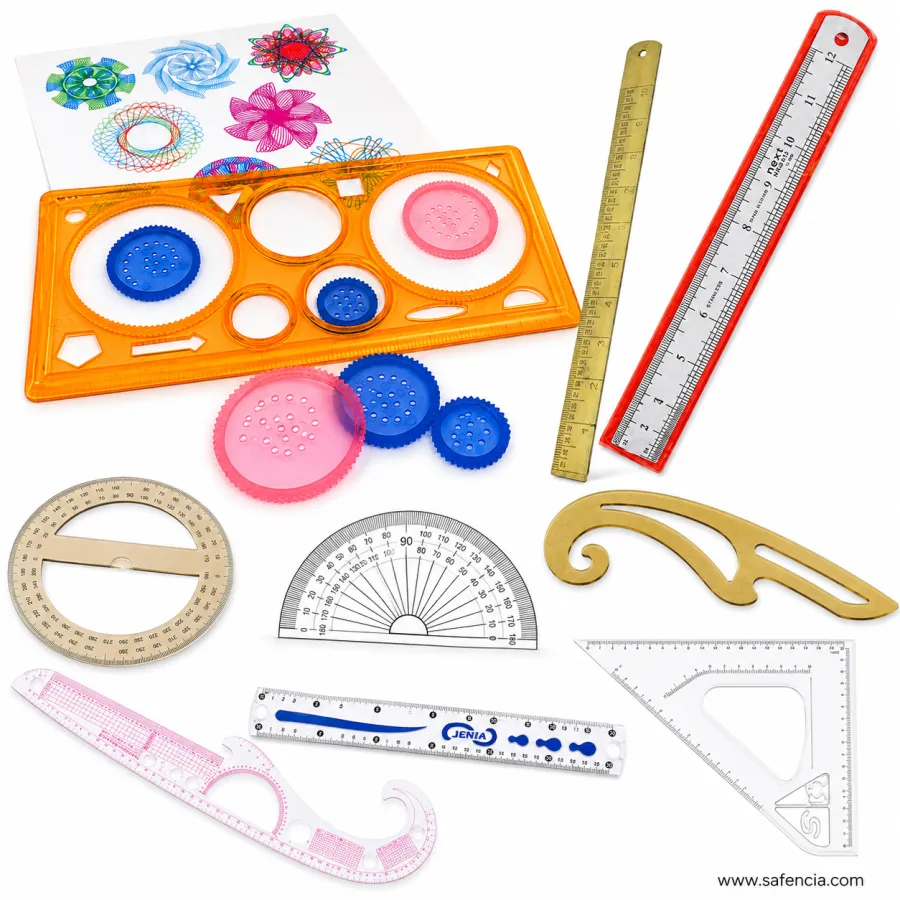
Length is the thing people get wrong when ordering online, so every listing states it in both systems: a 6 inch ruler is 15 cm, a 12 inch ruler is 30 cm, and the long rules are 24 and 40 inch. Check the number on your school list before you order — "one foot scale" and "30 cm scale" are the same item.
Pick by the job, not by the material. A child copying a maths diagram, a student drawing to scale, a tailor tracing an armhole and a draughtsman cutting a straight line all want a different edge.
For a school list
Most Pakistani school lists mean a 12 inch (30 cm) ruler. Transparent plastic is the cheapest and lets a child see the line underneath; wood survives being sat on; steel survives everything. A 6 inch ruler is the one that actually fits inside a pencil case.
For geometry and technical drawing
A set square or multifunctional geometry ruler does what a plain ruler cannot — fixed angles, parallel rulings and circle templates in one piece. Read the listing photo to see exactly which scales are printed on the model you are ordering.
For tailoring and design
French, textile and flexible curve scales are the pattern-maker's tools: necklines, armholes and hip curves that no straight edge can draw. The flexible curve bends and holds its shape, so it copies a curve you already have.
Ruler & Scale FAQs
Is a ruler the same as a scale in Pakistan?
In everyday Pakistani use, yes. Shops, school lists and students say "scale" far more often than "ruler", and in Urdu it is commonly called a foota (فٹا). All three words mean the same flat measuring edge. The word "scale" only means something different in phrases like a 1:12 model scale or a weighing scale.
What is the price of a ruler or scale in Pakistan?
Safencia's range runs from Rs. 25 to Rs. 1,600. Transparent plastic and thin wooden rulers sit at the bottom, steel rules and stencil rulers in the middle, and tailoring curve scales and the solid brass patwari scale at the top. Every current price is on the product card.
Should I buy a 6 inch or a 12 inch ruler for school?
A 6 inch (15 cm) ruler fits inside a pencil case and is enough for exercise-book work. A 12 inch (30 cm) ruler is what most school lists in Pakistan mean by "one foot scale" and is the safer default for geometry and diagram work. Many students carry both.
Which lasts longer — a plastic, wooden or steel ruler?
Steel, by a wide margin: it will not snap, warp or lose its edge, which is why it is the one to use when you are cutting against it. Wood is sturdier than plastic and does not crack, but can bow with damp. Transparent plastic is the cheapest and the easiest to draw under, and is the one children replace most often.
What is a brass patwari scale used for?
It is a heavy 12 inch brass rule of the type traditionally associated with revenue and land-record work in South Asia — the patwari's measuring scale. In practice people buy it today for its weight and its dead-straight brass edge, which suits drawing, cutting and desk use, as well as for gifting.
What is the difference between a French curve and a textile curve scale?
Both draw curves that a straight ruler cannot. A French curve is a compact profile with several radii on one piece, used for necklines, armholes and general curved joins. Textile curve scales are longer, garment-specific curves used in tailoring and pattern cutting. A flexible curve ruler is different again — it bends to a shape and holds it, so you can copy an existing curve.
Which ruler do I need for geometry class?
A 12 inch straight ruler covers the measuring, and a triangle set square adds the fixed 90°, 60° and 45° angles that geometry constructions need. A multifunctional geometry ruler combines straight edge, angles and circle templates in one piece, which is why students doing technical or engineering drawing tend to prefer it.
Is Cash on Delivery available for rulers and scales?
Yes. Safencia ships rulers and scales across Pakistan with Cash on Delivery. WhatsApp is used to confirm stock, the exact length you need, your delivery city and the delivery charges before dispatch.