Helix, external auditory canal, tympanic membrane, auditory ossicle, cochlea, triple semicircular canal and auditory nerve, laid out in the order sound travels.
in stock
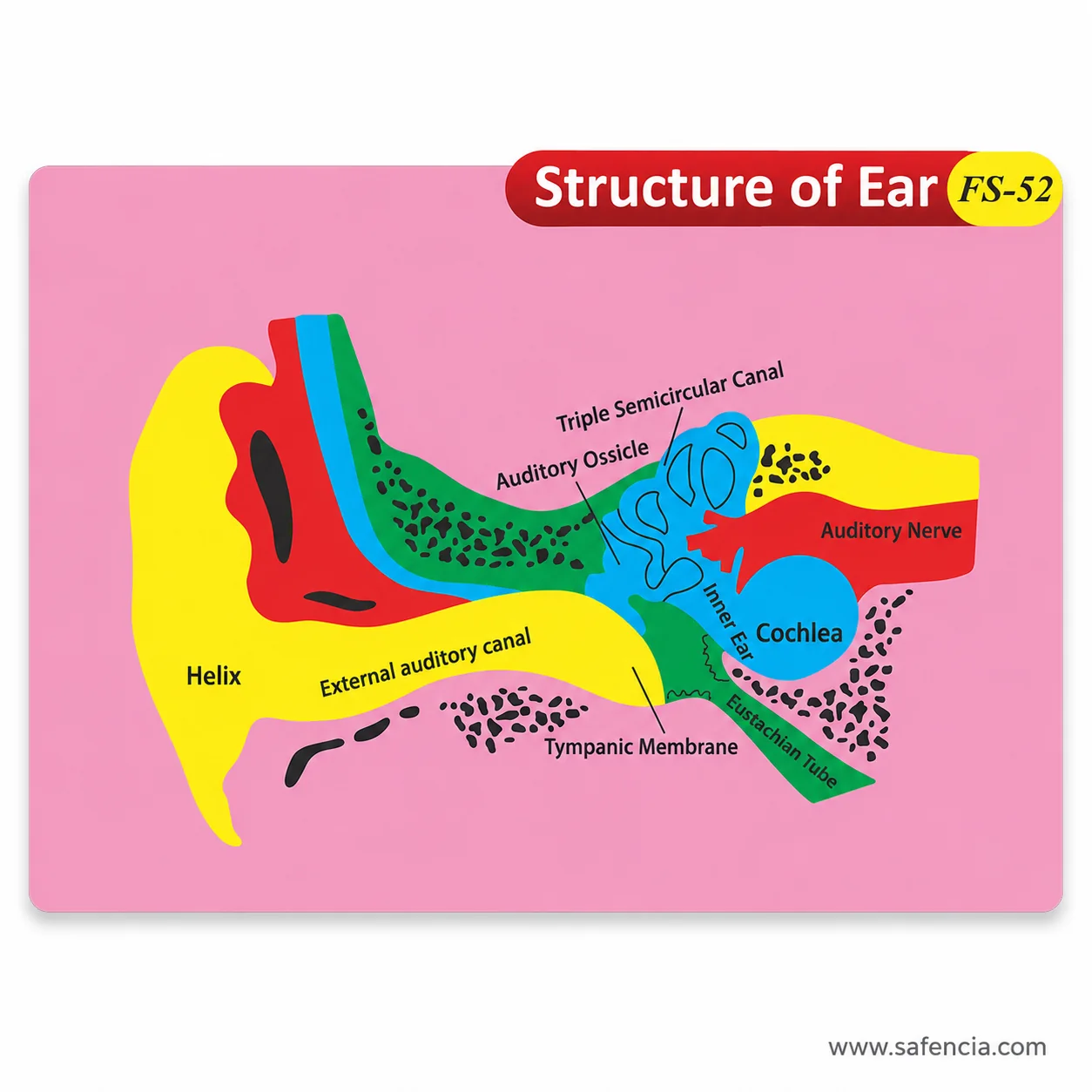
The full chart: a cut-through ear in coloured foam, labelled from the helix on the outside to the auditory nerve within.
Description
Sound has a route through the head, and this board follows it from the outside in. It begins at the helix, the curved rim of the ear you can pinch between two fingers, travels down the external auditory canal, strikes the tympanic membrane, is passed along by the auditory ossicle, and reaches the cochlea and the triple semicircular canal before the auditory nerve carries it away. The eustachian tube branches off below. Nine labels, one journey, in the order the ear actually uses.
The section is assembled from cut foam rather than drawn, and the colours are doing a job. Yellow marks the outer ear and its canal, red the fleshy detail behind it, blue the middle structures, green the tube heading towards the throat, and a solid blue circle stands for the cochlea. The black speckled patches are the surrounding bone. Because the whole thing is a cut-through, a child is looking at a slice of a head, which is a hard idea to picture and much easier to accept when it is sitting on a pink board in front of them.
It is a quieter chart to teach from than most. The eye can follow one continuous path instead of jumping between separate boxes, so a teacher can trace it with a finger and a class can repeat the route in order. Older pupils use the same board to explain why a blocked eustachian tube makes ears pop on the Motorway.
A word on one label. The chart prints triple semicircular canal, which is its own way of naming the three semicircular canals that handle balance. It is not the phrase a board exam will use, so it is worth saying the standard term aloud once when the topic comes up.
Foam suits a corridor wall better than card does. The edges do not fray where children pick at them, the corners do not roll up, and it stays where it is put through a whole school year. Nothing on the back is adhesive, though, and no size or mounting method is printed anywhere on the board, so we state neither. Ask us on WhatsApp and we will measure the stock in hand.
The price is Rs. 780 with Cash on Delivery right across Pakistan, Lahore, Karachi, Islamabad and Rawalpindi included. We confirm stock and your city's delivery charge on WhatsApp before dispatch.
Why this product is worth considering
Features
Specifications
| Product name | Structure of Ear Foam Wall Chart (FS-52, 9 Labelled Parts) |
|---|---|
| Category | Educational Toys |
| Recommended age | 3+ years |
| Model code | FS-52 |
| Subject | Human ear, cut-through section |
| Labels | 9 parts |
| Label list | Helix, external auditory canal, tympanic membrane, auditory ossicle, triple semicircular canal, inner ear, cochlea, auditory nerve, eustachian tube |
| Construction | Cut foam pieces raised on a pink foam board |
| Colour coding | Yellow outer ear, blue middle structures, green eustachian tube, speckled black bone |
| Banner | Red title banner with the code in a yellow oval |
| Fixing | No adhesive backing shown and no fixing method printed |
| Price | Rs. 780 |
| Stock status | In stock |
| Cash on Delivery | Available across Pakistan |
| Delivery time | 3-5 working days after WhatsApp order confirmation |
| What is included | 1 x Structure of Ear foam wall chart, Standard protective packing |
What's in the Box
- 1 x Structure of Ear foam wall chart
- Standard protective packing
FAQs
Which parts of the ear are labelled?
The Structure of Ear Chart carries nine labels: helix, external auditory canal, tympanic membrane, auditory ossicle, triple semicircular canal, inner ear, cochlea, auditory nerve and eustachian tube.
Does the Structure of Ear Chart show the inner ear?
Yes. It is drawn as a cut-through, so the cochlea, the semicircular canals and the auditory nerve are all visible rather than hidden behind the outer ear.
What does triple semicircular canal mean?
It is the chart's own wording for the three semicircular canals that control balance. Your textbook will simply call them the semicircular canals, so say that term aloud once when teaching from the Structure of Ear Chart.
Is it printed on the board or made from separate pieces?
Separate pieces. Every coloured region of the Structure of Ear Chart is cut foam laid on the pink backing, which is why the section has depth you can feel.
Which class does this suit?
The sense organs come up through primary and middle school, so the Structure of Ear Chart works from roughly Class 3 upwards and stays useful for revision in the senior years.
Does it come ready to stick on the wall?
No. There is no gum strip, no hook and nothing printed about mounting, so we make no claim about it. Schools usually fix these with double-sided tape or glue dots.
What are the dimensions?
No measurement appears on the board or the banner, so we will not quote one. Message us on WhatsApp before ordering and we will measure the Structure of Ear Chart in stock for you.
Is a reorder code printed on it?
Yes, FS-52, in the yellow oval at the end of the red banner. Quote it and the same ear chart comes back.
Can I pay cash on delivery for Structure of Ear Chart in Pakistan?
Yes. Cash on Delivery is available across Pakistan, including Lahore, Karachi, Islamabad, Rawalpindi and many other cities.
How fast is delivery in Pakistan?
Orders are confirmed on WhatsApp before dispatch. Delivery usually takes 3-5 working days in major Pakistani cities, depending on courier route and city.
Reviews
Be the first to review this product
We publish reviews from real customers after delivery. Already received this product? Share your honest feedback and we’ll feature it here.
Leave a review on WhatsAppRelated Products