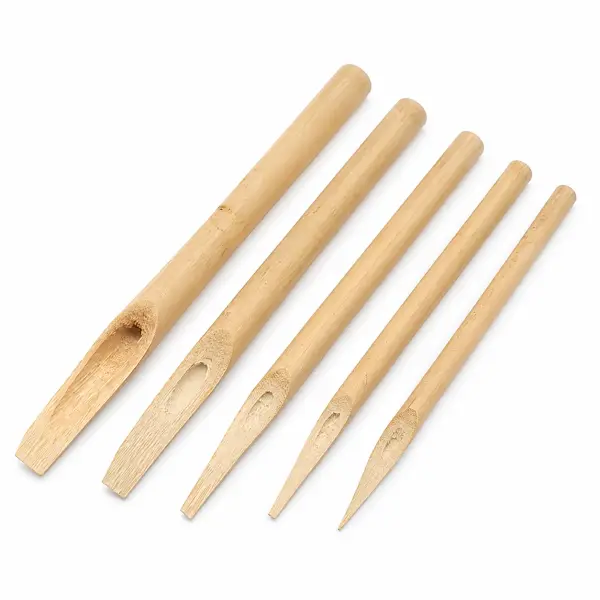
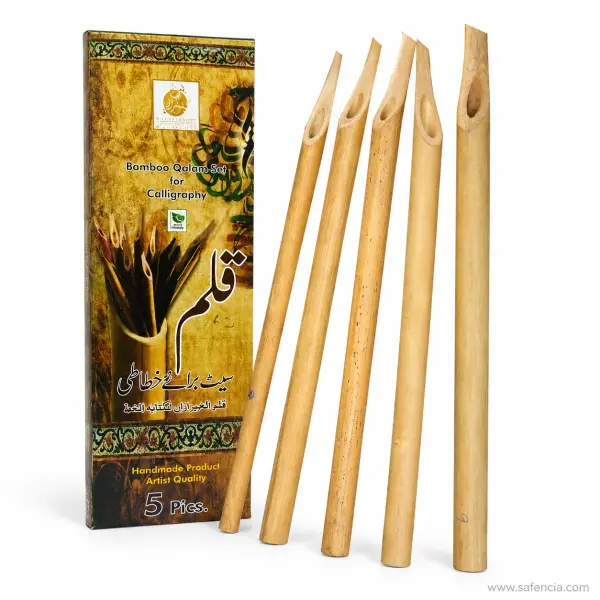
Khatati qalams run on one scale from 1 to 15, and these five are the top of it — the broad-nibbed end.
in stock
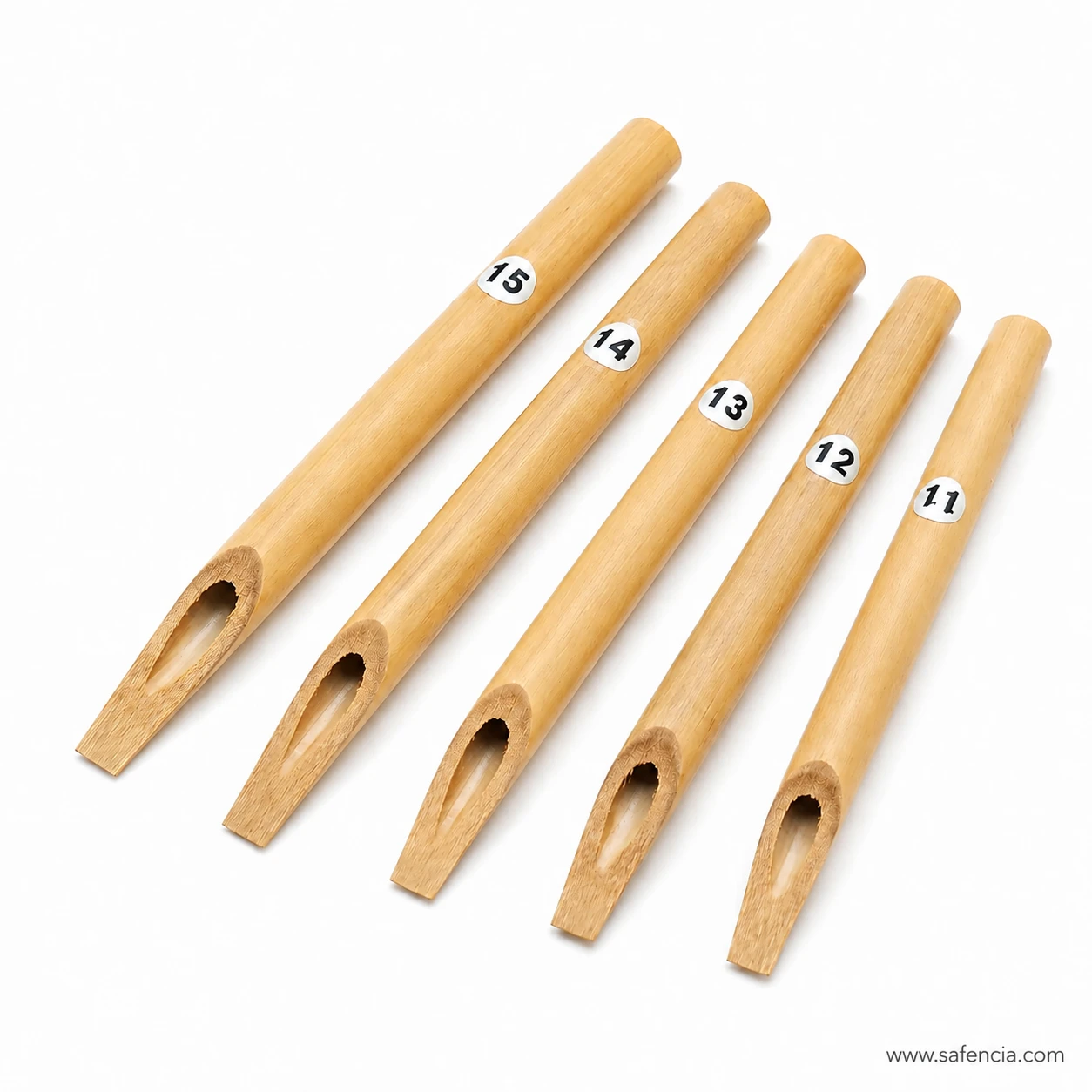
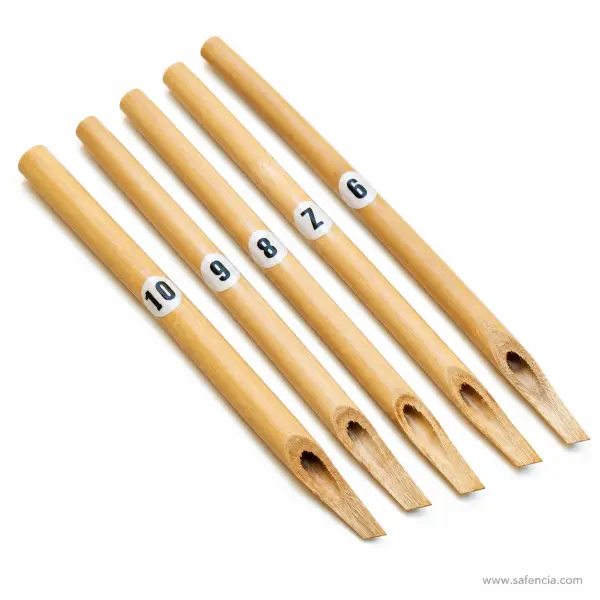
The full set of five, numbered 11 to 15 on the barrel. These are thick reeds with broad chisel tips — the top of the khatati width scale.
Description
The white sticker near the top of each qalam is the whole point of buying a numbered set. Khatati qalams are sold on one scale that runs from 1 up to 15, and the number is the width of the cut edge — put a No. 1 qalam next to a No. 15 and the difference is not subtle, one writes a hairline and the other a broad ribbon. This set is the top of that scale. These are the qalams you reach for when you are writing headings, titles, a bismillah across the top of a page, or practising letterforms large enough to see what your hand is actually doing.
Each nib is cut by hand, and the cut has three parts worth knowing. The tip is a chisel edge, sliced at an angle rather than sharpened to a point. Behind it a long channel is scooped out of the reed, which holds a small amount of ink. Down the middle of that channel runs a slit, and the slit is what carries ink from the scoop to the edge as you write. Nothing is manufactured onto the pen — the whole mechanism is cut into the bamboo.
That chisel edge is the reason Urdu and Arabic script look the way they do. Hold it at a steady angle and a downstroke comes out thick while a sideways stroke comes out hair-thin, and the letter changes weight as your hand turns through a curve. Nastaliq, Naskh and Thuluth are all built on that contrast. A ballpoint or a marker gives you one width in every direction, which is why practising khatati with one never quite looks right.
These are dip pens — no cartridge, no converter, no refill. You dip, let the surplus run off against the neck of the bottle, and write until the scoop empties. When the edge eventually frays it is re-cut with a blade at the same angle, which is ordinary upkeep for a reed qalam rather than a fault.
What arrives is the five qalams and nothing else. Ink is not included, and neither is a holder or a case — our photographs show the bare pens because that is exactly what is in the pack. If you are writing at ordinary exercise-book size, tell us on WhatsApp and we will point you at the lower-numbered sets instead; these five are deliberately the broad ones.
Safencia lists the No. 11 to 15 set at Rs. 420 with Cash on Delivery across Pakistan. Message us on WhatsApp before ordering and we will confirm stock for your city along with what the courier charges to your address.
Why this product is worth considering
Features
Specifications
| Product name | Khatati Qalam No. 11 to 15 Bamboo Calligraphy Pen Set of 5 |
|---|---|
| Category | Arts and Crafts |
| Recommended age | 8+ years |
| Product type | Hand-cut bamboo khatati qalam (dip pen) |
| Pieces | 5 qalams |
| Numbers marked | 11, 12, 13, 14 and 15 on the barrel |
| Nib | Chisel edge with a scooped ink channel and centre slit |
| Width band | No. 11 to 15 — the broad top of the 1-to-15 khatati scale |
| Material | Natural bamboo reed, unvarnished |
| Ink | Not included — the pack is five qalams only |
| Best for | Urdu Nastaliq, Arabic script, headings and large practice |
| Upkeep | Nib re-cut with a sharp blade when the edge blunts |
| Price | Rs. 420 |
| Stock status | In stock |
| Cash on Delivery | Available across Pakistan |
| Delivery time | 3-5 working days after WhatsApp order confirmation |
| What is included | 5 x bamboo khatati qalam, numbered 11 to 15, Ink is not included, No holder or storage case is included |
What's in the Box
- 5 x bamboo khatati qalam, numbered 11 to 15
- Ink is not included
- No holder or storage case is included
FAQs
What do the numbers 11 to 15 on these qalams mean?
They are positions on a width scale that runs from 1 to 15 across the whole khatati range, and the cut edge broadens as the number climbs. These five sit at the top of that scale, so all of them write a broad line — the steps between 11 and 15 are smaller than the jump from a No. 1 qalam to any of them.
Is ink included with this khatati qalam set?
No — ink is not included. The pack is the five bamboo qalams and nothing else: no ink, no holder and no case. These are dip pens, so you will need a bottle of calligraphy ink (siyahi) alongside them.
Which qalam number should a beginner start with?
For writing at ordinary exercise-book size, most learners start below this range. Numbers 11 to 15 are the broad qalams, best for headings, titles and practice sheets written large. Many people keep a wide set like this for display lines and a narrower set for everyday practice.
Which scripts is this bamboo qalam used for?
The angled chisel edge is what Urdu Nastaliq, Arabic Naskh and Thuluth depend on — the stroke turns from thick to thin as the hand moves through a letter. The same qalam also suits decorative headings and any lettering that needs weight contrast rather than one flat line.
What happens when the qalam nib goes blunt?
You re-cut it. A sharp blade takes a fresh slice at the same angle, and the qalam writes like new. That is normal upkeep for a hand-cut reed pen rather than a defect, and it is the reason a bamboo qalam outlasts pens with a moulded tip.
How is a bamboo qalam used with ink?
Dip the nib so the scooped channel fills, then draw the edge against the neck of the bottle so it does not flood the page. Hold the chisel edge at a steady angle to the paper and write until the ink runs out, then dip again. Wipe the nib after use and store the qalam nib-up.
Are these qalams bamboo or wood?
Bamboo reed, left in its natural colour with no varnish or paint. Each of the five is cut from a length of reed, so the grain, the exact shade and the barrel thickness vary slightly from pen to pen — that is normal in a hand-cut set and not a fault.
Can a school student use this khatati qalam set?
Yes, this is the sort of set used for khatati practice at school and at home from around eight years upward. The one thing to supervise is re-cutting the nib, because that step needs a sharp blade and should be done by an adult for younger children.
Can I pay cash on delivery for Khatati Qalam No. 11 to 15 in Pakistan?
Yes. Cash on Delivery is available across Pakistan, including Lahore, Karachi, Islamabad, Rawalpindi and many other cities.
How fast is delivery in Pakistan?
Orders are confirmed on WhatsApp before dispatch. Delivery usually takes 3-5 working days in major Pakistani cities, depending on courier route and city.
Reviews
Be the first to review this product
We publish reviews from real customers after delivery. Already received this toy? Share your honest feedback and we’ll feature it here.
Leave a review on WhatsAppRelated Products