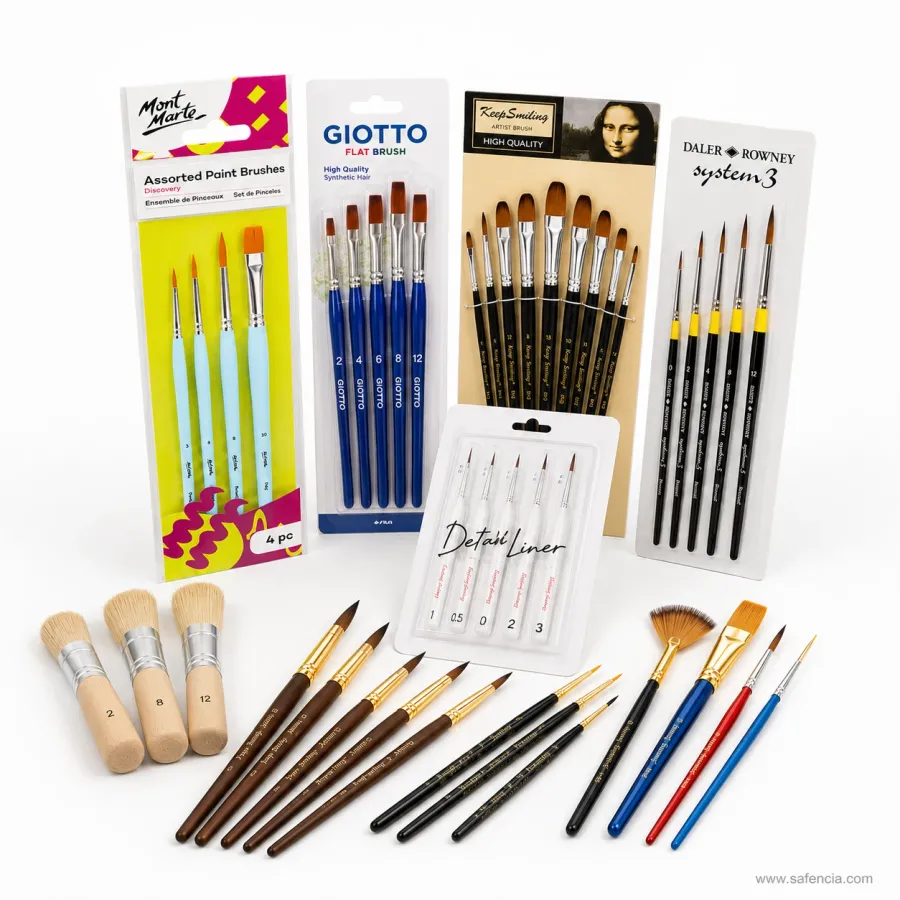
A paint brush is bought by shape, not by price, and that is the one thing almost no listing in Pakistan tells you. The shape of the head decides the mark it can make: a round draws a line and fills, a flat lays colour and cuts a straight edge, a filbert does both with no corner marks, and a fan blends. Buy the wrong shape and no amount of skill rescues the stroke — a beginner who buys three rounds and wonders why their edges look soft has a shape problem, not a talent problem. Safencia stocks 72 brushes from Rs. 65 to Rs. 8,075, and the tabs above split them the way they actually differ.
The second thing worth knowing is that a brush is judged at the tip, not on the shelf. A round should come to a point when wet and spring straight back; a flat should have square corners you can feel; a filbert should hold an even oval. What kills any of them is the same thing, and it is not use — it is paint left to dry at the base of the hair, where the head meets the ferrule. That hardens, splays the head permanently and no washing brings it back. Every brush page here says how to avoid it, because a Rs. 8,075 set and a Rs. 65 brush die of exactly the same neglect.
Start from the mark you want to make, never from the set that looks like better value. Six brushes of one shape is a narrower purchase than four of different ones, and the shapes below cover between them almost everything a painter does.
If you are buying your first brushes
Buy shapes, not sizes. A mixed set of four or six teaches you what a fan and a filbert are actually for, which is the knowledge that decides your next purchase. Six sizes of one round teaches you nothing you did not already know after the first.
If your edges never look clean
You need a flat, and you need to turn it. A flat painted face-on lays its full width; turned onto its narrow side it draws a straight line finer than any round in your jar. Most people own a flat for a year before anyone tells them the second half.
If you paint faces, petals or cloth
A filbert is the shape you are missing. It is a flat with the corners rounded off, so a stroke fades out instead of stopping in two hard corner marks that then have to be blended away. Portrait and still-life painters reach for it before anything else.
If a good brush went bad in a month
It was almost certainly stored wet, standing on its head in a jar. Water wicks into the ferrule, swells the glue and splays the hair. Wash, reshape while damp, and lay brushes flat or slot them into a roll or case — which is also the only safe way to carry them in a bag.
Paint Brush FAQs
What is the price of paint brushes in Pakistan?
Safencia's brushes run from Rs. 65 to Rs. 8,075. A single nylon base-making brush sits at the bottom, Keep Smiling and Giotto singles and small sets in the middle, and imported Daler-Rowney and Mont Marte artist ranges at the top. The current price is printed on every product card.
What is the difference between a round and a flat brush?
A round has a pointed tip and a belly of paint behind it, so one brush outlines a shape and then fills it. A flat has a square end, so it lays colour in fewer strokes and, turned onto its narrow side, cuts a straight line no round can match. If you are buying one brush, buy a round; if you are buying two, make the second a flat.
What is a filbert brush used for?
Curved shapes with no hard edges — petals, leaves, skin, clouds and folds of cloth. A filbert is a flat with the corners rounded off, so the stroke fades out instead of ending in two corner marks that have to be blended away afterwards.
Which paint brush is best for beginners in Pakistan?
A mixed set rather than a graded one. Four to six different shapes — a round, a flat, a filbert and a fan — teach you what each mark costs and what you will actually reach for. Safencia's mixed sets start at Rs. 245, which is less than most single artist brushes.
What is the difference between a rigger and a liner brush?
Very little, and the names are used interchangeably in Pakistan. Both have unusually long hair that acts as a paint reservoir so a thin line crosses the page without a join. A rigger takes its name from painting the rigging on ships; a spotter is the opposite tool, with very short hair for a controlled dot.
Are synthetic brushes as good as natural hair?
For acrylic, poster colour and school work, yes, and often better — synthetic springs back under thick paint and survives scrubbing that ruins soft natural hair. Natural hair still wins for a flooded watercolour wash, because it holds far more water. Most of this page is synthetic, and each listing says which it is when the pack states it.
How do I stop a new brush losing its point?
Wash before the paint sets and reshape the head between your fingers while it is damp. What kills a brush is paint drying at the base of the hair where it meets the ferrule — that hardens, splays the head and cannot be undone. Never leave a brush standing on its head in water, even for a few minutes.
How should paint brushes be stored and carried?
Flat, or upright with the head in the air — never head-down in a jar. For carrying, a brush roll or a zip case holds each handle separately with the heads clear, which is what stops the bend that no reshaping removes. Both are on this page under Cases & Care, and both are sold empty.
Is Cash on Delivery available for paint brushes across Pakistan?
Yes. Safencia offers Cash on Delivery nationwide. WhatsApp is used to confirm stock, the size where a brush is made in several, your delivery city and the delivery charges before dispatch.